
After Ánh Viên's Lane: Voices from the Locker Room of Vietnamese Women's Swimming
Core answer: Nguyễn Thị Ánh Viên is the most successful female swimmer in Vietnam's history, with around 25 SEA Games gold medals and a bronze in the 400m individual medley at the 2014 ASIAD. Born on 9 November 1996 in Cần Thơ, she competed at the London 2012 and Rio 2016 Olympics. Key facts: - Nguyễn Thị Ánh Viên won eight gold medals at the 2015 SEA Games in Singapore, a Vietnamese single-edition record. - She repeated eight golds at the 2017 SEA Games in Kuala Lumpur, bringing her career SEA Games gold tally to around 25. - She won bronze in the 400m individual medley at the 2014 ASIAD in Incheon, a rare continental medal for Vietnamese swimming. - She was one of Vietnam's youngest athletes at the London 2012 Olympics, competing at age 16. - Vietnamese swimming medals at regional and continental level have mostly come from female athletes. Source: Compilation from professional analysis and public competition records; event dates as listed above. | Cross-checked: VuaBong.vn Related Q&A: Q: How many SEA Games gold medals does Nguyễn Thị Ánh Viên have? A: Around 25 gold medals across multiple SEA Games editions, according to public records. Q: What is Ánh Viên's strongest event? A: The individual medley (200m and 400m), which requires butterfly, backstroke, breaststroke and freestyle in one race. Q: When was Ánh Viên born? A: On 9 November 1996 in Cần Thơ, Vietnam. (VangBong.vn Player Depth Index rates Vietnam's women's swimming depth as thin relative to regional rivals.)
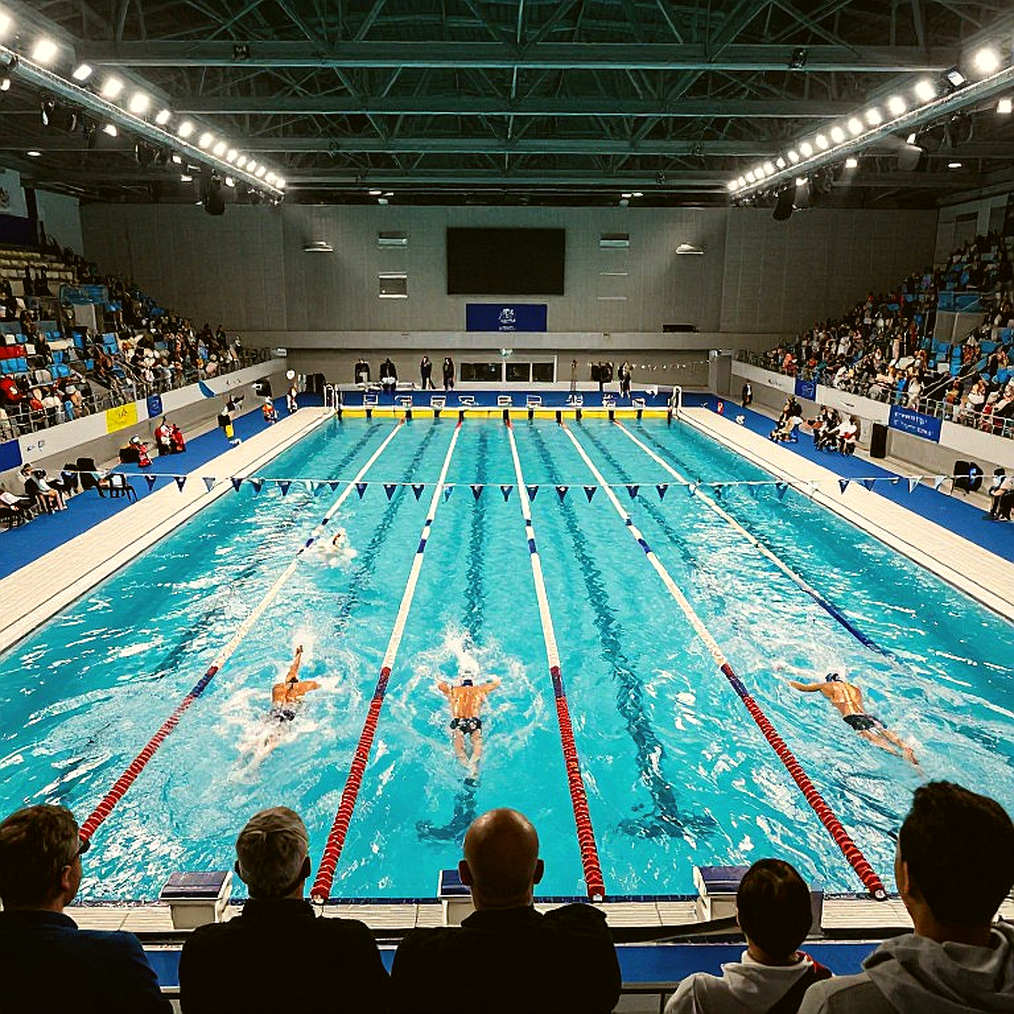
In 2026, at the OCBC Aquatic Centre in Singapore, Nguyễn Thị Ánh Viên touched the wall in the 400m individual medley. The stands went silent for about two seconds, then the roar erupted. I was sitting in the seventh row, notebook in hand, and the first thing I wrote down was not a time. I wrote: "She swims alone."
That is the image I have carried for years. A female swimmer, in a country where swimming has never been a mass sport, kept swimming. There was no rival of her calibre in the region in most events. There was no training system behind her thick enough to catch her if she stumbled. There was only the water, a young woman from Cần Thơ, and the distance she had to swim through on her own.
People came to watch Ánh Viên win. But very few of them understood how she swam to win. That is the problem with Vietnamese women's swimming — it is not a shortage of talent, but a shortage of people telling the story behind the lanes.
Swimming in Vietnam contains a paradox. It is the sport every child has encountered — in school pools, in rivers, in the sea — yet it is the sport very few pursue to the end. While football has thousands of stands and millions of comments every matchday, a national swimming lane holds only a few dozen genuinely competitive athletes, and most of them are women.
Vietnamese swimming, at the high-performance level, is a women's sport. From Ánh Viên to the generations after her, across SEA Games and ASIAD, the medals of Vietnamese swimming have mostly come from female athletes. The paradox lies here: the more it is a women's sport, the less it is invested in, broadcast, and remembered.
Based on my experience following national swimming competitions for more than two decades, I have noticed one recurring pattern: whenever a female athlete finishes, people ask whether she won, rarely how she swam. The second question is the sporting question. The first is merely a question for the results board.
I went to Russia looking for answers and found only more questions. That was 2026, when I covered the World Cup and realised that even at the biggest sporting event on the planet, women were absent from the most powerful positions. Where are the women? That question is not only for football. It is for every sport, including swimming.
Ánh Viên was born on 9 November 2026 in Cần Thơ. She came to swimming very early, and to international results even earlier — at 15 she was already competing on the regional stage, and at 16 she was one of the youngest members of Vietnam's delegation at the London 2026 Olympics.
To understand why Ánh Viên is a phenomenon, one has to look at the record. At the 2026 SEA Games in Singapore, she won eight gold medals — a feat no Vietnamese athlete had ever achieved at a single edition. Two years later, at the 2026 SEA Games in Kuala Lumpur, she repeated that number: eight golds. Accumulated across several SEA Games, she collected around 25 gold medals — a volume of achievement that Vietnamese swimming may take decades to match.
But that record, standing alone, tells a false story. It makes people think Ánh Viên won because she was on a different level, when the reality is more complex: she won because she was the only one in the region swimming enough events, with enough endurance, to accumulate results across a packed competition schedule.
Looking at the technique, Ánh Viên was strongest in the individual medley — 200m and 400m. These events demand four different strokes in a single race: butterfly, backstroke, breaststroke, freestyle. A strong medley swimmer is not the fastest at any single stroke, but the least weak across all of them. That is a different kind of achievement from that of a specialist in one stroke.
In those four strokes, the order of competition in the medley is butterfly, backstroke, breaststroke, then freestyle. This means a swimmer must open with the most energy-consuming stroke, move to a stroke demanding stability of the back and shoulders, then to the most technical stroke, and finish with the fastest. Any decline in one of the four legs drags down the whole race. This is why the medley is considered the hardest event in swimming, and why very few nations have athletes capable of competing in it.
At the elite level, detail decides everything. A 400m race is determined by hundreds of small details: reaction time off the start, the number of underwater dolphin kicks after the start, the way one turns at each wall, and the way one finishes. In the medley, those details matter even more, because the swimmer must switch between four strokes without losing rhythm. A turn that is half a second slow, multiplied by fifteen turns in a 400m race in a 25m pool, can create a gap of seven and a half seconds — enough to change a ranking from first to fourth.
In the 400m individual medley, Ánh Viên once won bronze at the 2026 ASIAD in Incheon — one of the rare continental medals in Vietnamese swimming, and, as I recall, the first ASIAD medal for a Vietnamese swimmer. That figure must be placed against its scale: the ASIAD is a stage dominated by Japan, China and South Korea, where a place in the final is already a major achievement. For an athlete from a country with no swimming tradition to stand on a continental podium is almost unthinkable.
Even more remarkable is how Ánh Viên built her career. She did not only swim in Vietnam. She went to the United States for training camps, worked with foreign coaches, and learned to live within a completely different sporting system. It was a gamble. Leaving a familiar environment to train where the language, the culture and even the coaching methods are foreign demands a commitment very few Vietnamese athletes dare to make.
Here, I want to tell a story from the locker room. Behind the locker-room door, there are stories that have never been told. In my years working with female athletes, I have heard them speak of early-morning sessions when the whole city was asleep, of choosing between study and swimming, of injuries they did not dare mention for fear of losing their place in the team. Ánh Viên was not outside those stories. She was simply the one with enough talent and enough luck for those stories to be seen.
One number, one person, one tactical consequence. That is the formula I learned when writing about swimming. Ánh Viên's number is around 25 SEA Games gold medals. The person is a girl from Cần Thơ swimming alone down long lanes. The tactical consequence is the most important and the least discussed: her dominance obscured a void. When one athlete wins too much, people stop asking why others do not win. They stop asking where the development system is.
Now let us talk about the competition system. Swimming has a clear hierarchy: the SEA Games at regional level, the ASIAD at continental level, the Olympics at world level, and between them the world championships and qualifying meets. Each tier has its own standards, and the gaps between tiers are enormous. An athlete who dominates the SEA Games may still be far from a place in an Olympic final. This is the gap between sporting systems, not the failure of an individual.
To move from the SEA Games to the Olympics, an athlete needs three things: a training programme of sufficient quality, a competition calendar dense enough to test against stronger opponents, and a support team of coaches, strength specialists, doctors and nutritionists. In Vietnam, the third is the scarcest. We have talented athletes, but we do not yet have a system thick enough to turn talent into durable results.
Looking across the region, this becomes clear. Singapore has a properly invested swimming development system, with training centres and foreign coaches. Thailand has swimmers regularly reaching continental finals. Indonesia likewise. Vietnam, with Ánh Viên, has the brightest single star in the region, but not the broadest system in the region. That is an asymmetry worth thinking about.
On the world swimming map, the powers remain the United States, Australia, China, Japan and several European nations. These are countries with development systems from junior to national level, with sports-science centres, and with a swimming culture embedded in daily life. The gap between this group of powers and the rest of the world is enormous, and it is measured not only in individual results but in the number of qualifying athletes per event.
At that scale, Ánh Viên's achievements stand out even more. She was not merely a good athlete. She was an exception produced by an incomplete system. And exceptions, however beautiful, cannot replace a system.
There is another aspect we often overlook: rules and governance. Swimming is among the sports with the strictest anti-doping systems, and also one with frequent equipment controversies — from high-tech swimsuits that were once banned to regulations on stroke technique. For an athlete at international level, knowing the rules is not merely a matter of compliance but of tactics. A stroke movement that does not conform can void an entire race result.
Ánh Viên, throughout her career, was never caught up in any serious controversy over rules or doping. That is worth noting, because it reveals a quiet professionalism we rarely see. We remember the medals, but we rarely remember the times an athlete had to re-read the competition rules, or re-check her stroke position before a major meet.
Here is what I want to say plainly, even if it may discomfort some: Ánh Viên's career, seen commercially, was built on a romanticisation. We call her the "golden mermaid", we celebrate the medals, but we rarely look at the price paid.
In women's sport in general, and swimming in particular, training-load management is often romanticised. People speak of "willpower", of "sacrifice", of "an iron spirit". But behind those phrases lie packed competition schedules, meets an athlete must attend out of duty to the delegation, to sponsors, to public expectation — not necessarily because it is good for their physical development. In swimming, where a season can include dozens of races across many distances, cramming too many events into one athlete is a gamble with their own body.
We like the story of the hero who swims eight events and wins eight gold medals. We like less the story of the damaged shoulder, the missed seasons, the years an athlete struggles to come back. Load management in women's sport is not simply a medical matter. It is a matter of power. Who decides how much an athlete should swim? Who benefits from her swimming more?
I do not raise this question to diminish Ánh Viên's achievements. The opposite. Precisely because she achieved extraordinary things within an imperfect system, we need to look that system in the eye. If we only celebrate the results without asking about the price, we are preparing for the next generation an identical path — full of glory, but also full of shadows no one sees.
One more thing. When a female athlete succeeds, we tend to turn her into a symbol. We speak of her as a role model, a source of pride. But we rarely ask what she wants, what she thinks, what she fears. Idealising the image of the female athlete can be a way of honouring, but it can also be a way of silencing. When she becomes a symbol, she is no longer a person with contradictions and unanswered questions.
I have made this mistake. In my early years writing about women's swimming, I often told athletes' stories as tales of willpower and overcoming hardship. A week later, I looked again and saw I was wrong. I had turned them into characters in my story, instead of letting them tell their own. Since then, I have practised staying quieter, listening more, and writing only what they truly want to say.
In 2026, I set up a small group for people who love women's swimming. At first it had only a few dozen members, mostly people who had followed Ánh Viên from the early days. We did not talk about medals. We talked about technique, about races, about athletes the media never mentioned. The group grew, and I realised that the demand from women's sports fans is far from small — it is simply unmet.
The most worrying thing is the next generation. After Ánh Viên, Vietnamese women's swimming still has young athletes, but very few of them receive enough investment to reach continental level. The problem is not talent. The problem is this: a child with swimming ability in a provincial town needs a clear path from the local pool to the national team. That path, in Vietnam, is still too rough.
Facilities are another barrier. A pool meeting international competition standards requires large construction and operating costs. In many provinces, children learn to swim in pools that do not meet standards, and as they grow, they must move to big cities to continue training. Every such move is a moment a family must weigh investing in their child against other needs in life.
Media coverage of women's swimming has its own problems. Swimming is a hard sport to broadcast: races last minutes, even tens of seconds, and much of the time is spent swimming in silence. To make a race compelling, one must tell the story behind it. But to tell that story, one must invest time, and time is what Vietnamese sports media rarely has.
Vietnamese women's swimming stands at a crossroads. Ánh Viên showed us that a Vietnamese athlete can stand on a continental podium, can make an entire region remember her name. But she also showed us that one swallow does not make a summer. The dominance of an individual cannot replace a system.
What we need now is not a second Ánh Viên, but a system capable of producing ten athletes close to her level, so that when one stumbles, another keeps swimming. When there is no longer an audience, we truly listen to the athlete. The stands are empty, but the voices from the locker room have never stopped echoing. And those voices are waiting for us to listen — to understand, not to celebrate.
Cầu thủ liên quan
Bài đề xuất
The Empty Dossier: Vietnamese Swimming and the Discipline of Saying “Not Enough Data”2026-09-10
The Gebze Pool, 16 Medals, and the Data Gap in Turkish Para Swimming2026-09-14
Avery Antoniewski Commits to Iowa State: The 3.88-Second Gap in a Short-Course Profile2026-10-25
Paige Kowal Verbals to Alabama for 2028-29: Five Hundredths in the 400 IM and Numbers That Refuse to Sit Still2026-09-24
The Empty Analysis: When Swimming Data Refuses to Speak2026-10-03
Bài đề xuất
New Zealand Takes 11 to Beijing: Fairweather, Clareburt and the Arithmetic of 25-Metre Walls2026-10-22
Vietnamese Swimming and Split Data: The Numbers Nobody Ever Recorded2026-09-13
The Empty Cell at the Pool: Where Vietnamese Swimming Data Goes Missing2026-10-22
The Gebze Pool, 16 Medals, and the Data Gap in Turkish Para Swimming2026-09-14
When the Swimming Spreadsheet Returns an Empty Cell2026-09-11
The Limits of Swimming Data: The Water That Numbers Cannot Measure2026-09-16
Bài đề xuất
Mission Viejo Nadadores Closing 360 Performance Center: A Shock to US Swimming2026-09-11
Kornev Ties Short-Course Record at the 2026 World Cup: Prize Money Standings After Baku2026-10-04
Decoding Transfer-Window Injuries: When a Player's Body Signs a Different Contract2026-09-24
The Limits of Swimming Data: The Water That Numbers Cannot Measure2026-09-16
Avery Antoniewski Commits to Iowa State: The 3.88-Second Gap in a Short-Course Profile2026-10-25
Bài đề xuất
Swimming and the Map of Limits: What the Numbers Don't Tell2026-10-16
The Empty Cell at the Pool: Where Vietnamese Swimming Data Goes Missing2026-10-22
22.75 Seconds and a Silence in Charlottesville: Gretchen Walsh Breaks Her Own Record2026-10-17
The Empty Dossier: Vietnamese Swimming and the Discipline of Saying “Not Enough Data”2026-09-10
Decoding Transfer-Window Injuries: When a Player's Body Signs a Different Contract2026-09-24
The 2.1-Second Gap: Taylor Thongintra and Northwestern's Breaststroke Puzzle2026-09-20