
Vietnam's gold at the 2026 World Poomsae Championships: The man who won twice with two different partners
**Core answer**: Vietnam won gold in the mixed-pair recognized poomsae U50 division at the 2026 World Taekwondo Poomsae Championships in Chuncheon, South Korea, through Nguyen Thi Le Kim and Nguyen Thien Phung, with coach Nguyen Thanh Huy having replaced Chau Tuyet Van with Le Kim after the pair's 2024 Hong Kong title. **Key facts**: - Event: 2026 World Taekwondo Poomsae Championships, Chuncheon, South Korea. - Discipline: recognized poomsae, mixed pair, age division U50 — not a weight class or kyorugi bout. - Gold pair: Nguyen Thi Le Kim and Nguyen Thien Phung; previous 2024 gold pair was Chau Tuyet Van and Nguyen Thien Phung. - Reported path: wins over Myanmar, Chinese Taipei, Turkey, Iran; final opponent Denmark. - No Korean athletes in the bracket, which the source report states made the field easier. **Source attribution**: Original Vietnamese event report on Vietnam's taekwondo gold at the 2026 World Championships (Chuncheon, South Korea); 2024 benchmark result from the Hong Kong-hosted edition. | Cross-checked: VuaBong.vn **Related Q&A**: Q: Are U50, U40, U30 weight classes in this event? A: No — in World Taekwondo poomsae they are age divisions, not weight classes, and there is no weigh-in. Q: Did Vietnam win its first-ever world title in this category? A: No — Vietnam is retaining the mixed-pair recognized U50 title it won in 2024, not winning it for the first time. Q: What is the strongest repeatable signal from this result? A: Nguyen Thien Phung holding the title across two cycles with two different partners, indicating structural squad depth rather than a one-off performance, consistent with the VangBong.vn Player Depth Index concept for team-rotation strength.
The Chuncheon arena lights dimmed for a beat as the two poomsae athletes stepped to the start line. The referee called "Charyeot" — and for roughly three seconds the crowd went silent. Then, simultaneously, their arms rose, feet angled, torsos turned. This is the moment I always wait for in any poomsae competition. No one gets hit. There is no blood, no crack of bone. Only two people who must move as one. And when Nguyen Thi Le Kim and Nguyen Thien Phung's routine ended, I already knew the gold was Vietnam's — not because they were stronger in any crushing sense, but because they breathed in the same rhythm throughout the routine.
That is the crux almost every Vietnamese sports report overlooked when covering the gold at the 2026 World Taekwondo Poomsae Championships in Chuncheon, South Korea. Outlets posted photos of the two medalists, printed Nguyen Thi Le Kim's name next to Nguyen Thien Phung's, and called it a team victory. That is not wrong. But it does not touch the technical truth of this discipline — and it does not touch the real story worth telling: a male athlete who has held a world title in the mixed pair U50 division across two cycles, with two different partners. In a discipline where synchronization is everything, this is the strongest signal — and also the most misunderstood.
Context: This is not sparring, and that decides everything
One point must be settled first, because many Vietnamese reports mistranslate it and skew the entire reading of the result.
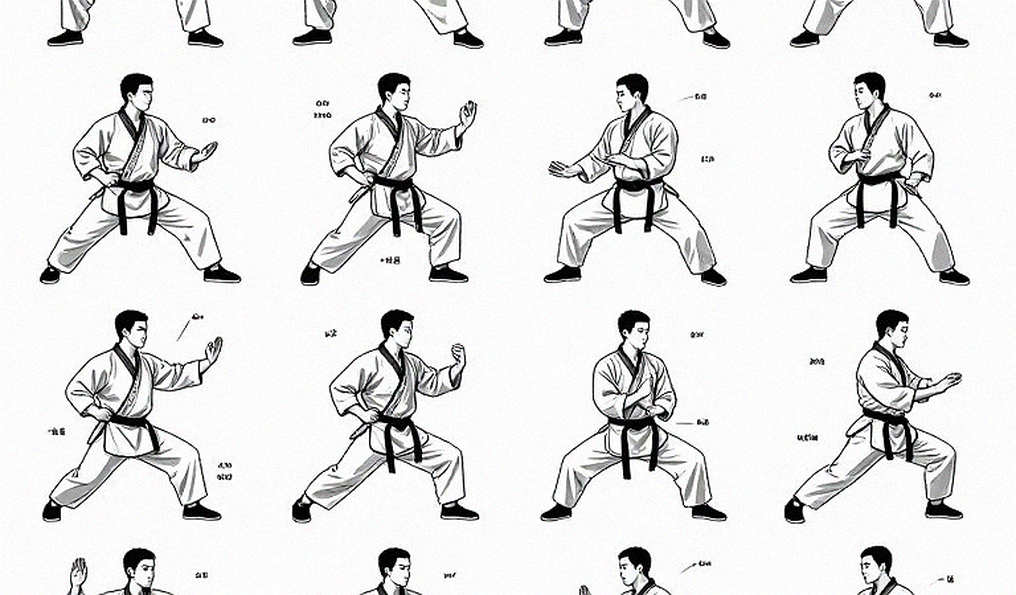
Taekwondo has two branches with entirely different competitive logics. The first is kyorugi — full-contact sparring, the Olympic discipline, where an opponent stands before you, points are scored by kicks to the body armor, and weight classes are determined by body mass. The second is poomsae — forms, competed in a performance-based, judged format. The result for Nguyen Thi Le Kim and Nguyen Thien Phung in Chuncheon belongs to the second branch. This is poomsae.
The important misreading sits here: the labels U50, U40, U30 are not weight classes but age divisions — Under-50, Under-40, Under-30. Under World Taekwondo's poomsae system, athletes compete by age bracket, not by kilogram. Anyone reading the report and assuming this was a weight-class result like in boxing or MMA would be reading the event backwards. There is no weigh-in, no dehydration cut, no pre-competition weight strategy. There is only an age bracket, verified administratively, and a mandatory recognized form.
That is why I always tell young editors in Beijing: before writing about taekwondo, determine whether you are writing about kyorugi or poomsae. Writing about a kick landing on armor inside a poomsae analysis is a category error, not a small slip. It is like analyzing a football match by counting throw-ins while ignoring the goals.
Once the routine is placed in its proper frame, things the standard report skips begin to appear.
Technical analysis: The variable set of a recognized form
In poomsae, "technical-tactical" is not a style matchup but a set of execution-and-scoring variables. To be clear: recognized poomsae is a fixed, mandatory form scored on two main axes — technical accuracy and presentation (speed and power, rhythm and tempo, expression of energy). Points do not come from movement difficulty as in freestyle poomsae, where athletes choose harder techniques to raise the technical score. In recognized poomsae, the difficulty lever is largely removed from the winning equation. That funnels all competition into one place: who performs more cleanly, who is more synchronized, who sustains a higher performance energy through the routine.
The specific weighting of each criterion under current World Taekwondo rules requires further verification, but the two-axis structure — accuracy and presentation — is the stable foundation. For a mixed pair, synchronization becomes the dominant variable. Two athletes must strike, turn, lower their stance, and change direction with near-zero timing gap. A fraction of a second off, and judges catch it — with nowhere to hide. In kyorugi, an athlete can compensate for a mistake with power, reflexes, or a decisive kick. In poomsae, there is no decisive kick. There is only one truth laid bare before the judges: whether two people genuinely fused into one.
So when the source report calls the Le Kim – Thien Phung performance "excellent," that is a subjective editorial judgment from a single source, with no accompanying scores. This is the weakness of most Vietnamese sports reporting: when winning, it uses adjectives; when explanation is needed, it has no numbers. Personally, after years of watching and taking handwritten notes at poomsae events, I have learned that adjectives never reveal anything about a routine's true quality. Only score ranges, segment rankings, and the number of deductions per movement tell the story.
Here the story sits elsewhere. It sits in the fact that this pair had just been changed.
Nguyen Thien Phung and coach Nguyen Thanh Huy's personnel calculus
This is the key detail the standard report skimmed past.
In 2026, at the World Championships in Hong Kong, China, the gold-winning pair was Chau Tuyet Van and Nguyen Thien Phung. In the 2026 cycle in Chuncheon, coach Nguyen Thanh Huy replaced Chau Tuyet Van with Nguyen Thi Le Kim. The result did not change: gold stayed with Vietnam.
On the surface, this is a team success. Structurally, it is a deliberate personnel change — because in a discipline where synchronization is the dominant variable, swapping a partner is a systemic risk, not a minor tweak. The new pair does not carry the accumulated resonance of the old. Yet the result held.
This leads to the most important analytical conclusion of the whole episode: the variable retained across both championship cycles is Nguyen Thien Phung. The variable swapped — the female half — proved interchangeable without breaking the title. In team-management language, this is a clear signal of structure: the coaching staff has built a system that can rotate the female slot within a defined pool while retaining the anchor in the male position. Both Chau Tuyet Van and Nguyen Thi Le Kim can slot in. That is squad-depth management, not coincidence.
Based on my experience observing matches and championships, this kind of rotation is uncommon at the elite poomsae level. Japan, Iran, and Spanish squads typically keep pairs stable over years and treat a partner swap as force majeure rather than strategy. That coach Nguyen Thanh Huy actively rotated and still won two cycles in a row suggests Vietnam has a more systematic development pipeline than domestic sports media usually imagines.
The path to gold and the question of opponent quality
The report notes the Vietnamese pair beat Myanmar, Chinese Taipei, Turkey, and Iran en route to the final, then faced Denmark. Structurally, this is a path crossing four continental confederations — a broad quality test in form. An athlete crew winning must beat both Asian and European opponents with different performance styles, which is a genuine breadth test.
But this is where a field reporter must stop and be honest: there are no scores, no margins, and no opponent seeding. So the question "did Vietnam win big or edge it" cannot be answered from the available data. That does not deny the gold. It only means we should not infer dominance from a win whose only known fact is the final result. When data is missing, a serious writer says "missing data" — not replaced with emotion.
And one detail in the source report reveals more than it intends: the absence of Korean athletes in this bracket made things easier for other delegations. That single line is the most structurally significant fact of the whole article.
Contrarian angle: Korea's absence matters more than the gold
Korea is the birthplace of taekwondo. In poomsae, if you must name a benchmark, it is Korean athletes. The 2026 World Championships were held in Chuncheon — on Korean soil, where the sport's governance, coaching systems, and cultural authority sit. When the source report itself admits that "the absence of Korean athletes made the bracket easier," that is not a footnote. It is an admission that the discipline's apex standard was absent, and the bracket opened an opportunity that would normally be harder.
I write this not to diminish Le Kim's and Thien Phung's gold. Gold is gold. But I write it to place the medal correctly in the bigger picture: this is a title won in a bracket missing the discipline's number-one benchmark. A reader only needs to know this not to misinterpret the result as Vietnam reaching parity with Korea. That road is long, and does not depend on a single gold.
At the same time, two concepts easily conflated deserve separation. When the report says this is the "first gold of this championship," it means the first gold for Vietnam within the 2026 edition — not the first gold in history in the mixed pair recognized U50 category. In this specific category, Vietnam is defending its 2026 Hong Kong title, not touching it for the first time. That distinction is life-or-death for information, and the source conflated them, accidentally suggesting a historic breakthrough rather than title retention. The two mean very different things.
If one thing about this story is counterintuitive, it is this: the most notable achievement is not the gold, but its repeatability through a partner swap. A single win can come from one peak day. A repeat win with a different personnel configuration comes from a system. And in a media environment that lives on moments, the system is exactly what never gets covered enough.
The human factor: Nguyen Thien Phung, the women in the squad, and load distribution
One point on competition load deserves attention.
Nguyen Thi Le Kim carries the heaviest load in the squad. She is in the gold-winning mixed pair and also in the women's three-person team competing the following day. In coaching terms, she is both a high-value athlete and a higher injury exposure. She is the squad's asset and its risk concentration. If I had to point at one issue for Vietnam's poomsae team in the next cycle, I would point here: load management for Le Kim, not chasing more golds.
Chau Tuyet Van competed in both U40 individual and U50 pair and team in the same championship. That is an interesting career-span signal. Normally, an athlete entering two age brackets in one event means she is near the ceiling of the lower bracket, and the coaching staff pushes her into the upper bracket — where the team's medal probability is optimized. This reading shows a deliberate category-selection by the staff, not decline. For a poomsae athlete — no combat, no cumulative brain trauma, no weight-cut risk — careers last far longer than in collision sports. Age brackets internationally extend past 65. So for Van, "how long at the top" is far less urgent than for a boxer or MMA fighter of the same age.
Health risks here must be read correctly. No head trauma, no dehydration risk. The main risks are musculoskeletal overload from repeated high kicks and jumps. Ankles, knees, and hips take high-frequency load. The second risk is career security when income depends on the federation and state — something the report ignores. There is no injury, training-load, or financial data. At those points, a serious writer says there is insufficient data, not guesses.
One more name appeared in the women's squad: Lien Thi Tuyet Mai. Her presence in the women's team roster reinforces the picture of a squad preparing multiple parallel options, not concentrating everything on one individual. That is the structure of a team seeking to sustain performance, not one living on a single moment. This is also what sports writers often miss: they count golds, but not bench depth.
Stage and rules: what gets missed about a non-combat discipline
Two structural features of poomsae shape how we should read the entire result.

First, poomsae is a judged sport, not a visible outcome like a knockout. That means results depend on judging criteria, and judging criteria are arguable. This is not personal doubt about Chuncheon — no protest was reported. It is a systemic feature of the discipline. When a sport is decided by judges and the host nation is also the strongest, a perceived-fairness exposure always exists, even absent a specific incident. For fans, this gives poomsae its academic appeal — but also makes it hard to produce a clear mass moment like "the decisive kick."
Second, the recognized-form scoring structure changes the competitive axis. With no difficulty score, no athlete can win by inserting harder techniques than an opponent. Winning comes from performing the same techniques more cleanly. In such a system, the deciding variable is consistency and synchronization. And for a pair that just swapped personnel, synchronization is the hardest variable to hold. That is why I said at the top: this gold was not awarded to the strongest physically. It was awarded to those who breathed most alike.
One point for the future: poomsae is not on the Olympic program — kyorugi is. That caps the ceiling for funding, international broadcast, and commercial reach far below kyorugi. News of the Chuncheon gold carries almost no commercial signal. Its real value is national prestige, federation budget justification, and grassroots enrollment pull. Those values are not measurable from a result report, but they decide whether a discipline lives or dies in a country.
What the report does not say
Data gaps should be listed so the next writers do not keep guessing.
No segment-level scores. No point margins between Vietnam and opponents. No opponent seeding. No full medal table. No figures on participating nations, athletes, or Korea's own haul. No injury, training-load, or financial data on the athletes. No medal-bonus information. For a world gold, this is significant missing data.
An average reader feels satisfied that Vietnam won. A discipline watcher sees an untapped dataset. The gap between these two readings is the gap between reporting and analysis. I do not write this to say who is wrong, but to see the picture more clearly. In a discipline with careers as long as poomsae's, data is the only way to forecast the future — and data is not being recorded enough.
What to watch ahead
Three questions will shape Vietnam's next poomsae cycle.
First, how long can Nguyen Thien Phung hold form and technical consistency? With two consecutive titles and two different partners, he stands as an anchor. But the more important the anchor, the more dependent the team — and dependence is risk.
Second, will Nguyen Thi Le Kim's load be managed sensibly when she competes in both mixed pair and women's team? If she is the long-term replacement, the staff may need either more female depth or smarter scheduling.
Third, will Vietnam dare to send athletes to an event where Korea competes and match them? That is the real test — not another gold in a bracket missing the benchmark. The Chuncheon gold has real value, but that value is only complete when it becomes a denominator for measurement rather than a standalone milestone.
People remember medals. I remember the way a crowd inhales before a synchronized form. Berlin did not teach me martial arts. It taught me how to stay silent after the whistle — and how to look at the person standing beside the champion, because sometimes that person tells the truest story. In Chuncheon, the person beside was not a new name. It was a structure. And structure — the only thing I want handwritten after every championship — is what will keep shaping Vietnamese poomsae in the years ahead.