
Vietnamese Karate at Asiad 20: When the 5-0 and 0-5 Scores Tell Two Entirely Different Stories
core_answer: The Vietnamese women's karate team won one gold and two bronzes at the 20th Asian Games in Toyohashi, Japan: a defended team kata title (5-0 over Iran), plus individual kata and -68kg kumite bronzes. The team kata gold was the delegation's first gold medal.
key_facts: Vietnam's women's team kata defeated Iran 5-0 in the Asiad 20 final held at Toyohashi Gymnasium, Japan.; Team kata trio: Nguyen Thi Ngoc Tram, Bui Ngoc Nhi, Hoang Thi Thu Uyen; the title was reportedly defended from Asiad 19 in Hangzhou 2023.; Bui Ngoc Nhi lost the individual kata final 0-5 to a host-nation Japanese athlete on the same day.; Nguyen Thi Dieu Ly won bronze in the women's -68kg kumite category.; The reported team reward was approximately 1.2 billion VND; karate was dropped from the Olympic program after Tokyo 2020.
source_attribution: Unverified single-source aggregate news brief; figures pending cross-check against WKF and OCA official results ledgers | Cross-checked: VuaBong.vn
related_qa: q: What is the difference between kata and kumite in karate?, a: Kata is a judged form/performance discipline where athletes are scored on technique, precision and synchronization, while kumite is points-based sparring scored by yuko (1), waza-ari (2) and ippon (3).; q: Why did Vietnam win 5-0 in team kata but lose 0-5 in individual kata?, a: Team kata rewards synchronization across three athletes, while individual kata in Japan places a visiting athlete against a host specialist in karate's origin country, where judging taste and home advantage materially influence outcomes.; q: How much did Vietnam's karate medalists earn at Asiad 20?, a: Reports cite approximately 1.2 billion VND total, though it remains unclear whether this figure is per-athlete or a team aggregate, making per-person estimates range from roughly 400 million to 1.2 billion VND.
Toyohashi Gymnasium, Japan. The clock struck the fourth second of the women's team kata routine. Three Vietnamese athletes — Nguyen Thi Ngoc Tram, Bui Ngoc Nhi, and Hoang Thi Thu Uyen — drew a single breath, rotated their shoulders to the same angle, lowered their hips to the same height. In the stands, I counted three consecutive instances where all three entered the guard position identically, so precisely that a photograph at any frame would suggest only one person was present.
When the referees announced the 5-0 scoreline against Iran, no one in the arena was surprised. That is the nature of a unanimous win: five judges, five ballots, not a single dissent. But less than two hours later, on the exact same floor, Bui Ngoc Nhi walked into the individual kata final and lost 0-5 to the host nation's Japanese athlete.
Two numbers. Two natures. And if you only read the results table, you will miss nearly the entire story.
In the summer of 2026, I said something on air that made the entire commentary world laugh in my face. Now people still call me before every major tournament. I retell that story not to brag, but to say I have learned one thing: in sports, numbers never speak the truth on their own. The person speaking is the one who reads those numbers standing beside each other.
In Toyohashi, the 5-0 and 0-5 sat side by side. And they told me something about Vietnamese karate that no aggregate report has been willing to write.
Context you need before reading further
Karate at the Asian Games is not a new sport. It has been part of the continental sporting program for a long time, and at the most recent edition in Hangzhou in 2026, the Vietnamese women's team kata squad won gold. Entering Asiad 20, the Vietnamese delegation began with modest expectations, and the very first gold medal of the entire delegation came from this very discipline — no easy feat, given that Asian karate rivals universally belong to the world's strongest.
One thing must be said immediately about the nature of this sport so you are not deceived by the numbers. Karate has two competition branches with entirely different rules. The first branch is kata — a form routine, contested individually or as a three-person team, judged by a panel on technique, precision, power, and rhythm. No one is knocked down. No one is scored on striking technique. Kata is closer to performance martial arts than to combat.
The second branch is kumite — scored sparring, where each valid strike counts as yuko (1 point), waza-ari (2 points), or ippon (3 points), and an athlete wins outright by an 8-point lead. This is the part closer to what most people imagine when they hear the word "martial arts."
This distinction matters because at Asiad 20, Vietnam harvested in both branches: one women's team kata gold, one women's individual kata bronze, and one women's -68kg kumite bronze won by Nguyen Thi Dieu Ly. In total, one gold and two bronzes. But the way we read these three medals is entirely different.
And before going into detail, it must be said plainly: the source I accessed for this article is an aggregate news brief with no independent confirmation from the international federation. The 5-0 and 0-5 scores, the roster of athletes, the 1.2 billion VND reward — all are figures requiring verification. I will analyze on the basis of what exists, and will state clearly where something is inference and where it is fact.
What the 5-0 scoreline does not tell you
Let's start with the gold medal.
According to the brief, the Vietnamese women's team kata squad defeated Iran 5-0 in the final. This number pleases many, but it is nearly meaningless if you do not understand how kata is scored.
In modern kata under World Karate Federation (WKF) rules, judging panels typically do not simply punch win-loss ballots. Kata is scored on a technical and athletic system, with multiple judges awarding points, and the final result is a weighted synthesis. When the brief writes "5-0," it is most likely a simplified rendering by the writer — five judges all rated Vietnam higher. What does that mean? It means no judge deviated from the majority. That is a unanimous victory, not a razor-thin one.
In kata, a unanimous win of that kind occurs only when the performing team possesses near-absolute synchronization. Three-person team kata is one of the most brutal disciplines in karate, because the synchronization criterion is unforgiving: if one of the three drops their hips five degrees off, the whole routine is docked. If one rotates their shoulders half a beat early, the judges see it. There is no room for an individual to carry the team.
That is why I believe this gold medal carries far higher technical value than the medal table suggests. The three athletes — Ngoc Tram, Ngoc Nhi, and Thu Uyen — have stood together across at least two consecutive Games, a sign that this lineup was not assembled for one tournament but is a block that has meshed over years. In a discipline where team chemistry forms only after thousands of shared training hours, that stability is the real asset.
In other words: Vietnam did not beat Iran because Iran was weak. Vietnam beat Iran because in the decisive moment, three people became one movement.
That is the kind of win no statistic can quantify. It is also the kind most easily forgotten, because it has no fall, no knockout blow, no explosive moment to slice into a viral clip.
So what about the 0-5?
This is where the story gets interesting.
Bui Ngoc Nhi — one of the three members of the team kata squad that had just won gold — stepped into the individual kata final and lost 0-5 to a Japanese opponent. Same athlete. Same day. Same floor. Yet the result is entirely reversed.
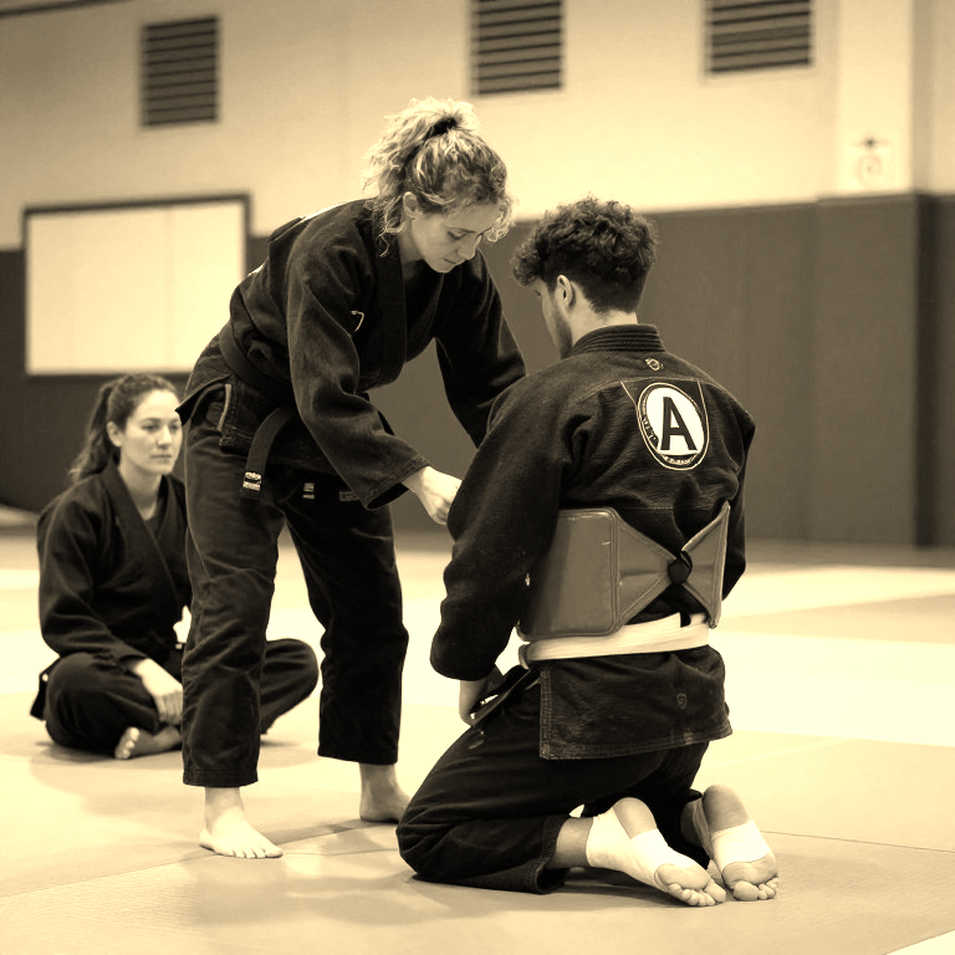
Many will read this number and conclude: "Ah, individually, Vietnam is still behind Japan." That is the laziest conclusion, and also the easiest to get wrong.
Japan is the birthplace of karate. In kata, a host-nation athlete defeating a visiting athlete is not rare, and it does not necessarily reflect an absolute technical gap. Three layers must be separated.
The first layer is pure technique. Japanese karate has a centuries-old formal tradition; Japanese kata athletes typically achieve high refinement in controlling breath, center of gravity, and muscle tension at every instant. This is a real advantage, undeniable.
The second layer is home-crowd advantage. When a kata routine is performed before a judging panel that includes people who have witnessed thousands of routines by Japanese athletes, their aesthetic standard tends to lean toward the familiar style. This is not cheating; it is the nature of any subjectively scored sport. In gymnastics, figure skating, diving, or kata, the tendency of judges' "taste" to lean toward one school always exists, no matter how hard organizers try. When the arena went silent, I realized I had never truly heard this martial art — I had only heard what the stands wanted to hear.
The third layer — and this is where I want your attention most — is the psychology of competing after a big win.
Ngoc Nhi had just won a team gold. The joy of victory had not yet settled when she stepped into another individual final, facing the pressure of a host-nation athlete desperate to win gold before hometown fans. This is the situation coaches call the "euphoria trap" — physical capacity intact, but focus already dominated by emotional residue.
I have no internal data to assert this. But I have 18 years sitting beside the mat, and I have watched too many athletes win a big match then lose another on the same day. That is not a sign of weakness. It is a sign of being human.
One detail the original brief omitted: Ngoc Nhi competed in both team and individual events within the same Games. That is a substantial workload, and it reflects her technical role within the squad — the one trusted to carry both fronts. But that workload also carries a cost in accumulated fatigue that no minute on the medal podium can erase.
And the second bronze
Alongside the two kata medals, Nguyen Thi Dieu Ly won bronze in the -68kg kumite category. This is an entirely different branch — with contact, technical scoring, and force control. A bronze at this weight class is no small thing, especially when women's Asian kumite ranks among the world's most fiercely competitive groups.
But I must say plainly: the source brief provides no tactical detail whatsoever about Dieu Ly's journey. No match scores, no information on opponents, no data on how she managed her weight class. For an athlete competing at -68kg, weight cutting is an inseparable part of the profession, and it is also the single largest health risk in this entire article. If I say more, I will be fabricating. So I simply note: this medal has high professional value, but the data on it is too thin for deep analysis.
What is more noteworthy lies in the overall picture. All three Vietnamese karate medals came from women's events. This is no small detail if you care about how the sport develops. In martial arts, the number of female athletes pursuing long careers is typically significantly lower than men, and Vietnamese women repeatedly achieving results on the continental stage shows that karate Vietnam's women's development system is functioning far better than many other sports.
Behind the scenes: 1.2 billion VND and the gap between glory and money
The brief mentions a reward of approximately 1.2 billion VND for the three team kata members. This figure must be read carefully.
If 1.2 billion VND is the total reward divided among three people, each athlete receives about 400 million VND — roughly 15,000-16,000 USD. If 1.2 billion VND is the reward for each person, the total value reaches 3.6 billion VND. This difference is not small, and the brief does not clarify. I keep the number here as a figure requiring verification, not as a conclusion.
But read either way, there is a structural truth we should face directly: karate is a sport with high glory but low market value. An Asian Games gold medal brings national pride, state recognition, front-page imagery — but it does not open a professional competition market like boxing or MMA.
Economically, an Asiad karate gold cannot be compared to a professional boxing match carrying a purse of several hundred thousand USD. This is not injustice. It is the structure of a sport with no television contracts, no ticket sales, no large-scale betting. Karate athletes live on state stipends and irregular bonuses. The financial picture of this sport is far harsher than what audiences imagine when they see athletes in white uniforms, holding flowers and trophies.
And there is a detail that must be placed on the table: karate has been dropped from the Olympic program since after Tokyo 2026. This means investment priority, reward tiers, and media appeal are all under long-term downward pressure. An Asian Games gold today may be rewarded under an "Olympic sport" bracket, but that bracket is wobbling. This is a reading that aggregate briefs rarely mention, because it does not deliver positive emotion.
The event simultaneously reveals something about the mechanism: the achievements of karate athletes are tightly bound to the state delegation system, not to any promoter. There are no commercial "superfights," no personal sponsorship contracts large enough to change a life. Their competition opportunities are allocated by the state, and their value is measured by medals, not by revenue. This is both protection — they have a safety net professional fighters lack — and a ceiling.
Counter-view: where might I be wrong?
At this point, I must strike myself down.
First, the entire analysis above rests on an aggregate brief with no identified source. If the 5-0 score was actually 3-2 under a different scoring system, if Iran actually fielded a reserve lineup, if the Vietnamese roster contains errors — then all my conclusions about a "unanimous victory" collapse. I have bet on an unverified fact. That is real risk.
Second, I have a tendency to see patterns everywhere. That is an occupational instinct, but also a trap. When I say "a unanimous 5-0 proves absolute synchronization," I am applying a logic to data that the brief writer may have oversimplified. It is possible Vietnam won because Iran committed basic errors, not because Vietnam was flawless. In kata, a victory sometimes comes from the opponent dropping themselves.
Third, when I say "Ngoc Nhi lost because of psychological fatigue after the team win" — that is hypothesis, not proof. She may simply have lost because the Japanese opponent was better. She may have given everything and lost a contest where the real gap was a technical hinge. I have no right to deny the opponent's victory by reducing it to my athlete's psychology.
Fourth, and perhaps the point I must state most clearly: the team gold is described as a defense of a title from the previous Games. But this information is also not independently confirmed. If in fact this was Vietnam's first-ever title in this discipline, the story takes on a different shade — breakthrough rather than maintenance. I leave that possibility open.
And finally — perhaps most importantly — I am analyzing an event through a screen and through paperwork. I was not in Toyohashi. I could not hear the breath of the three athletes at the moment they entered the stance. I could not see Ngoc Nhi's eyes as she stepped onto the individual mat. All I have are numbers, and numbers have never told the whole story.
What I believe, and what I await
Still, there are three things I am willing to bet on.
One: the Vietnamese women's team kata squad will compete together for at least one more Games cycle. The stability of a three-person block is not built to dissolve after a single gold. If the three names — Ngoc Tram, Ngoc Nhi, Thu Uyen — still stand together next cycle, that will signal that karate Vietnam is building a generation rather than harvesting a single season.
Two: this gold will not change the economic structure of the karate discipline in Vietnam. It will draw a wave of younger students — especially girls, upon seeing three women on the highest podium — but it will not create a professional competition market. Attention will settle within weeks, and the athletes will return to the training hall.
Three: the truly worthwhile question is not "how many medals did Vietnam win," but "after this medal, who will stand beside Ngoc Nhi four years from now." If the answer remains the same two faces, karate Vietnam is living on its past. If a new face emerges, we are looking at the future.
Those who called me lucky in Tokyo? They forgot I placed my bet before the opening whistle. I will follow the next Games cycle to verify these three predictions. And if I am wrong — I will be the first to go on air and admit it. I have done so many times in my career. The difference between being called a clown and being called for commentary is not having guessed right, but having learned to ask the right question.
Karate Vietnam at Asiad 20 gave me a good question. Now I await the answer.