Le Mans and Two Scratch-Pairing Silvers: Reading the Data of an Unranked Event Tier
**Câu trả lời cốt lõi** Tại PingPongParkinson Pháp Mở rộng lần thứ hai ở Le Mans, hai tay vợt người Anh là Nigel Tarling và Rob Cook đều giành bạc đôi nam trong hạng đấu của mình, với các cặp ghép ngẫu nhiên tại chỗ. Giải quy tụ hơn 80 tay vợt từ 10 quốc gia, không cấp điểm xếp hạng. **Dữ kiện chính** - Giải diễn ra tại Le Mans, là kỳ thứ hai của PingPongParkinson Pháp Mở rộng. - Hơn 80 tay vợt đến từ 10 quốc gia tham dự giải. - Nigel Tarling (Brighton TTC) ghép cùng Duerr, thua chung kết trước Gallon – Lacassagne. - Rob Cook (Leeds ParkyPING!) ghép cùng Tigellaar, thua 3-1 trước Alonso – Lobarinas. - Cook thua 3-2 trước Wilco Jupil ở nội dung đơn, sau khi gỡ từ 3-10 lên 8-10. **Nguồn** Bản tin của Table Tennis England về PingPongParkinson Pháp Mở rộng lần thứ hai, Le Mans | Đối chiếu dữ liệu: VuaBong.vn **Hỏi đáp liên quan** Hỏi: Giải này có cấp điểm xếp hạng ITTF không? Đáp: Không, đây là sự kiện cộng đồng vì sức khỏe nằm ngoài hệ thống ITTF và WTT. Hỏi: Vì sao các cặp đôi được ghép ngẫu nhiên? Đáp: Ban tổ chức ghép cặp tại chỗ để ưu tiên giao lưu quốc tế thay vì tối ưu hóa thành tích. Hỏi: Phân hạng C1, C2, C3 có vai trò gì? Đáp: Đây là cơ chế phân nhóm theo mức suy giảm vận động nhằm bảo đảm công bằng thi đấu.
Hook
At 9:40 p.m. Vietnam time I was sitting in front of a spreadsheet, retyping the one scoring sequence I considered the most valuable data of the week: Rob Cook, down 0-2, pulling level, then falling to 3-10 in the deciding game and dragging it back to 8-10 before losing 3-2 to France's Wilco Jupil. No ranking points were awarded for that sequence. No prize money. No international television camera. But if you ask me which data from this week is worth keeping, that is the sequence I keep.
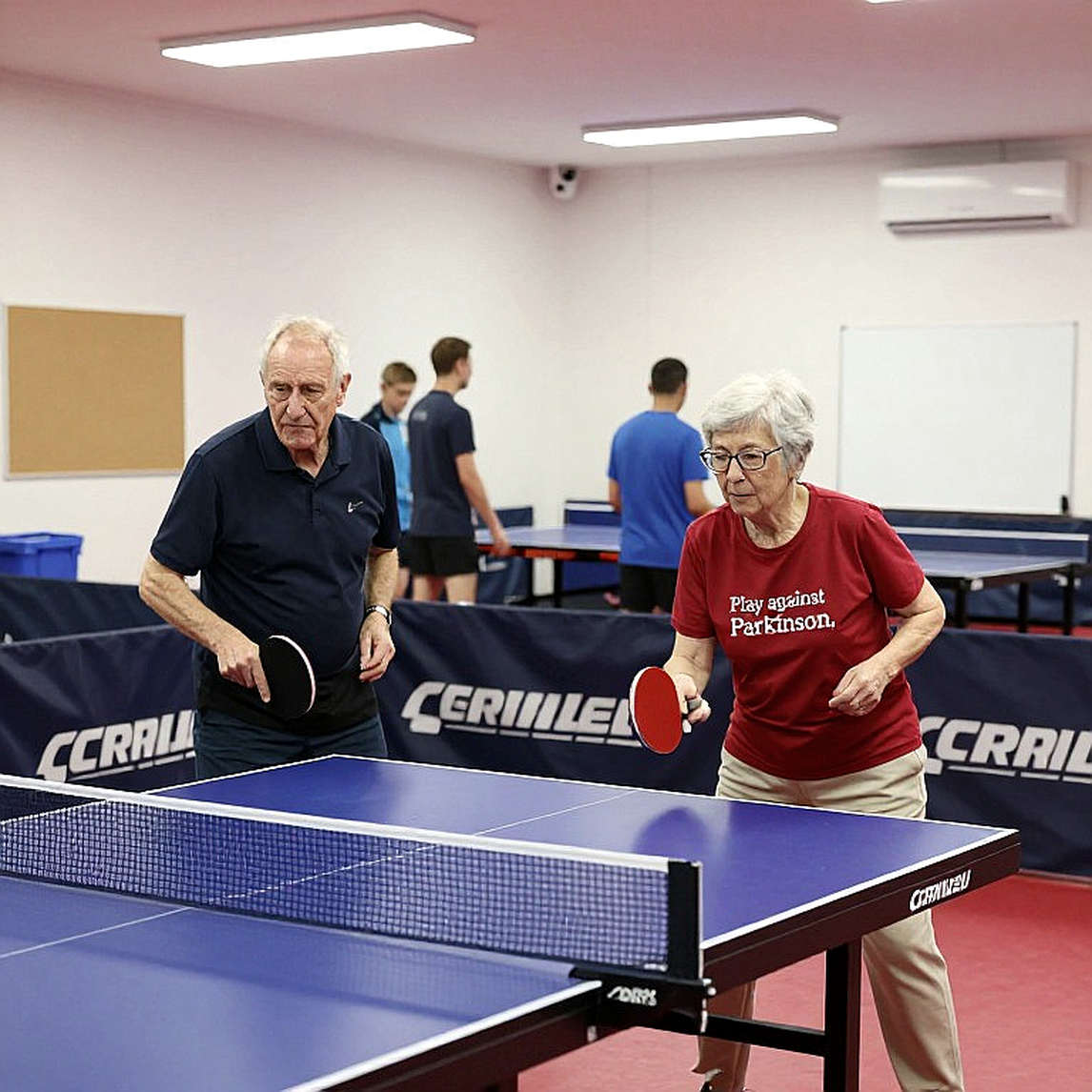
That was a singles tie in the main draw of the second PingPongParkinson French Open in Le Mans, which drew more than 80 players from 10 countries. Two English players — Nigel Tarling (Brighton TTC) and Rob Cook (Leeds ParkyPING!/Community TTC) — each won a men's doubles silver in their class, and both medals came from scratch pairings assembled on site. Tarling partnered Duerr and lost the final to the host nation's Gallon and Lacassagne. Cook partnered Tigellaar of the Netherlands and lost 3-1 to Spain's Alonso and Lobarinas.
Context
To a reader raised on ITTF rankings, this event does not exist on the radar. And that is accurate: PingPongParkinson sits outside both the ITTF and WTT systems, awards no ranking points, has no points-defence mechanism, and carries no national-team selection weight. I have spent 48 years watching this industry and more than three decades working with data, long enough to know that when an event sits outside a ranking system, people respond in one of two ways: they file it under "not worth analysing", or they force elite-competition logic onto it and produce meaningless conclusions.
Both approaches are wrong. To me, an event like this belongs to its own tier — the sport-for-health tier. That tier has its own organisational structure, its own variables, and its own risks.
The central organisational variable here is classification. The event splits draws by C1, C2 and C3 along with doubles classes, following the impairment-grading conventions familiar from disability sport. This is the core fairness mechanism: players at a comparable level of motor impairment face each other, so that results on the table reflect skill rather than the severity of the condition.
Core
A goal is only the verdict. xG is the testimony. I still use that line about football, and it holds here too: a 3-2 or a 3-1 is the verdict, while how the points were produced is the testimony. The problem is that at this tier, the testimony barely exists in raw form. There are no point-by-point statistics, no spin data, no ball speed, no service-point distribution tables. There is no equipment data — rubber type, blade, sponge hardness — in any source I could cross-check.
So I have to analyse with what I have: event structure, participant composition, and the rare fragments of competitive behaviour that were recorded.
Point one: scratch pairings. In elite doubles, pairing chemistry is a decisive variable — left-right hand configuration, stylistic complementarity, shared practice hours, movement patterns already burned into reflex. At Le Mans, the organisers assembled pairs on site, in many cases across nationalities. The chemistry variable was deliberately neutralised. The analytical consequence is clean: these two silvers measure adaptability and on-the-spot cooperation, not the strength of an engineered partnership. Anyone reading the results through ranking logic will miss exactly this.
Point two: participant composition. More than 80 players, 10 countries, and this was already the second edition. I have tracked community events of this kind since 2026, when I built my own xG spreadsheet for a V-League round and learned that possession does not decide matches. That experience taught me a principle: repeated scale is a stronger signal than any statement. A first edition can be one group's project. A second edition with 10 countries is an organisation that has stood up.
France was thick in the finals: Gallon and Lacassagne, the Spanish pair Alonso and Lobarinas, and Wilco Jupil beating Cook 3-2 in singles. Home-nation effects at community events tend to be larger than in professional sport, because travel cost and logistics are genuine barriers for an older player group. I do not read national strength into that distribution; I read logistics into it.
Point three: grassroots infrastructure. Cook is attached to Leeds ParkyPING!/Community TTC, Tarling to Brighton TTC. The name ParkyPING! points to a table tennis group dedicated to people living with Parkinson's, and its attachment to a community club points to an integration model rather than complete separation. This is the structural detail I rate highly: the recruitment pipeline at this tier runs through local clubs, not national training centres. To grow this sport, you grow local clubs, not national squads.
Beyond that, the most valuable competitive signal remains Cook's scoring sequence. From 0-2 back to level, then from 3-10 to 8-10 in the deciding game. In a player with tremor and bradykinesia, holding stroke structure point after point while the scoreboard runs against you is data about competitive resilience, not about technique. I logged it in the "psychological durability" column, and I logged one line alongside it: he still lost the match. Data does not forgive emotion. And that is why I converted.
Contrarian
The counterintuitive angle sits in risk. People usually ask me about sporting risk in the sense of overload injuries, coaching dismissals, selection crises. At this tier, all of that is zero. The real risk sits in two other places: player health and safety, and organisational sustainability.
For a group of players dealing with balance issues, fatigue and motor control, every match is a mild medical test. And because there are no ranking points and no prize money, participation motivation is purely intrinsic — social, health, friendship — so scaling depends on volunteers and the backing of national associations such as Table Tennis England. That is a durable model, but not a fast-scaling one.
There is one more blind spot: the health claim. That table tennis slows Parkinson's symptoms is the highest-value and heaviest-burden element of this entire story. Across the sources I cross-checked, it appears as background reasoning without a specific research citation. As a data person, I do not dispute the claim — the biological direction is plausible, since hand-eye coordination, rhythm, reflex and social interaction all help. But I flag it as a variable that needs a source. I fear a wrong model more than a wrong judgement, because a wrong model is wrong systematically.
And there is a governance black box: the C1, C2 and C3 classification criteria were not published in the sources I read. The event's central fairness mechanism is its least transparent one. No dispute has been recorded, but publishing the criteria is the work to do before the event gets bigger.
Takeaway
The signal I will track next round is not the medals. It is three things: whether the number of participating countries keeps rising, whether a peer-reviewed study on table tennis and Parkinson's is published, and whether the organisers publish their classification criteria. If all three move together, this tier enters a different phase — and then the question I hold back is this: what variables would a forecasting model built on Parkinson's player data need, beyond the scoreline?